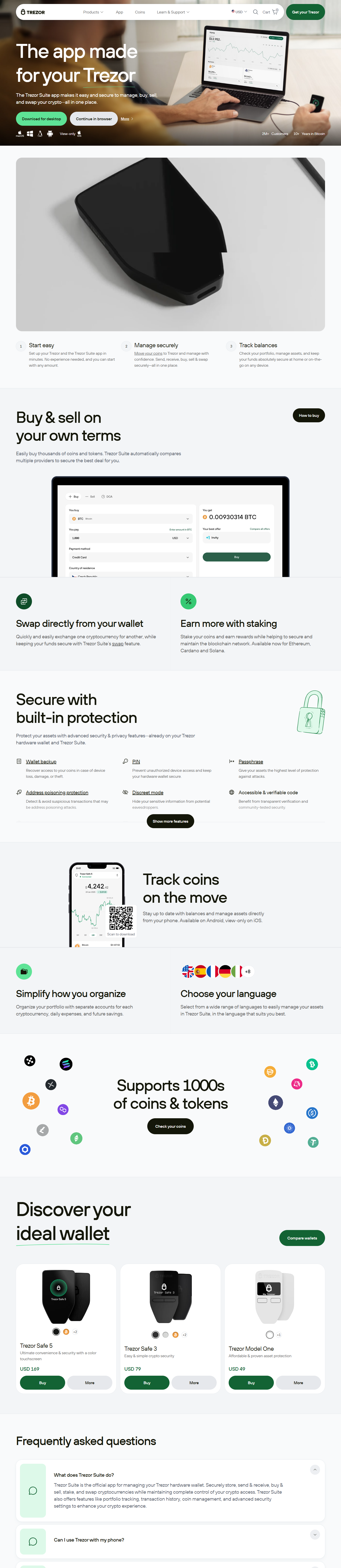
This single-page studio guide provides the fundamental security and setup steps for your new hardware wallet, emphasizing digital self-sovereignty and risk mitigation.
PHASE I: Preparation and Verification
The journey into self-custody begins long before you transfer your first asset. The initial steps of unboxing and verifying your device’s integrity are non-negotiable security protocols. Upon receiving your hardware wallet, you must meticulously inspect the packaging. Look for any evidence of tampering, such as damaged seals, opened boxes, or signs of re-taping. The official manufacturer packaging employs specific security features designed to break if disturbed. If any irregularity is noted, you must immediately contact the official vendor and refrain from using the device. This initial due diligence ensures that no malicious firmware or hardware components have been introduced into your device during transit.
Next, download and install the official Trezor Suite desktop application. Never rely on links provided in third-party emails or advertisements. Always navigate directly to the official Trezor website and download the software from the verified source. The Trezor Suite acts as your secure gateway to managing your digital assets. Installing this software correctly is the foundation of a secure operational environment. Once installed, connect your device to your computer. The Suite software will guide you through the initial device authentication process, confirming it is a genuine, non-counterfeit unit. This step is critical and utilizes cryptographic proofs unique to the official hardware.
01
Firmware Installation (The Core OS)
The first required action for any new hardware wallet is updating or installing the latest official firmware. The Trezor Suite will automatically prompt you to perform this operation. Firmware is the operating system of your wallet, and running the latest version ensures you have all current security patches and feature updates. **Never install third-party or unofficial firmware.** The process involves a signature verification within the Suite application, which cryptographically confirms that the code running on your device originates directly from SatoshiLabs. This step wipes the device clean, ensuring any hypothetical pre-installed seed is removed, preparing it for the generation of your unique, truly random private keys.
02
Generating and Securing the Recovery Seed
The Recovery Seed (or Seed Phrase) is the single master key to all your funds, typically a sequence of 12, 18, or 24 words. This sequence is generated **offline** by your Trezor device and is never stored on a connected computer or transmitted over the internet. You must write this seed down **physically** on the provided recovery cards—do not take pictures, store it in digital files, or enter it into any online service. The integrity of your seed is paramount; if it is compromised, your assets are compromised. After writing it down, the Suite will ask you to confirm a few words in a specific order to verify that you have recorded it correctly. Store the physical cards in at least two separate, secure, and geographically diverse locations, such as a fireproof safe or a bank vault. Losing your device is recoverable; losing your seed is fatal to your self-custody efforts.
03
Setting Up Your Device PIN
The final critical security layer is the PIN. This numerical code prevents unauthorized access to your Trezor device if it falls into the wrong hands. When entering the PIN, the device screen will show a randomized grid of numbers, while the computer screen displays a blank input field. This method, often called the "scrambled keyboard," defeats keylogging attempts, as the position of each number changes with every single use. Choose a PIN of at least eight digits for maximum entropy and memorize it. Note that too many incorrect attempts will exponentially increase the time delay between subsequent attempts, making brute-force attacks practically impossible. Following these steps completes your device setup, securing your gateway to the decentralized world.